Eckhart Tolle experienced a profound spiritual awakening after a long period of depression. He described the experience as the dissolution of his mind-made self and the beginning of a life rooted in presence. Byron Katie had an awakening that eventually led her to understand that much of our suffering comes not from what happens, but from believing our stressful thoughts about what happens.
My story isn’t one of those stories. I didn’t have an epiphany where the clouds parted, my ego dissolved, and suddenly all my struggles disappeared. Some people seem to have these experiences. Just like some people experience what has been called “spontaneous sobriety,” where their relationship with alcohol simply ends. No struggle. No compelling voice. Just freedom.
That wasn’t my experience with alcohol either.
Most of my life seems to happen differently. I get Data Points. I have experiences that give me an opportunity to notice old programming, beliefs, and behaviors, and then I get to decide what I want to do with the information. Sometimes the Data Points are small.
And sometimes, apparently, I need a fucking 911 Data Point.
If it’s true that life happens for me, then even the moments I would never choose can contain something worth finding. And this one contained a lot.
My grandmothers used to say, “Always have clean underwear on because you never know when you’ll end up in the emergency room.”
Turns out underwear was going to be the least of my concerns.
Over the past couple of weeks, I’ve learned more than I ever wanted to know about diverticulum, diverticulosis, and intestinal bleeding. What I learned most dramatically is that diverticular bleeding can happen suddenly, and there can be a lot of blood.
One morning, I started having bloody diarrhea. A lot of bloody diarrhea. But there was something confusing about the whole thing: I wasn’t in pain. I wasn’t dizzy. I wasn’t lightheaded. I didn’t feel like someone who was experiencing a medical emergency. So despite what was very clearly happening in the toilet, part of me kept saying, I’m fine.
Eventually concern won, and I went to urgent care. After seeing what was happening, they immediately sent me to the emergency room. I headed to Desert Regional in Palm Springs, where I continued bleeding into a public toilet while I waited to be seen.
The doctor didn’t seem overly alarmed, which I suspect was at least partly intentional because I was already alarmed enough for both of us. Because I had no pain and had a history of diverticulosis, the working assumption was diverticular bleeding and that my body would likely heal itself. What she really wanted to know was whether the episodes were slowing down and whether there was less blood.
They were. A little.
And apparently “a little” was enough for me to start negotiating with reality.
I was embarrassed by what was happening. I didn’t have any pain. I wasn’t feeling weak or lightheaded. I wanted to go home, take care of myself, and put this whole humiliating experience behind me.
Before I left, the doctor gave me one very specific instruction: “If your lips turn white, come back immediately.”
So I went home.
No pain. No lightheadedness. No dizziness.
I was going to be fine.
I settled onto the couch with Ash, turned on the TV, drank a protein shake to get some calories in me, and tried to rest. I had a couple more large evacuations, which somehow still didn’t alarm me enough to do anything. Then I looked in the mirror.
My lips turned white.
With that information, I decided the appropriate course of action was to fill my water bottle, sit down for a little while, settle my nerves, and then decide whether I should go back to the emergency room.
Because apparently I needed additional data.
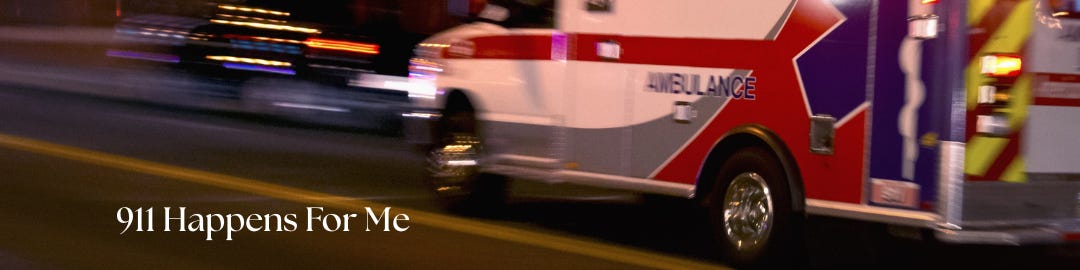
I walked into the kitchen and turned on the faucet. Suddenly my hands started shaking. The bottle fell into the sink. I could feel the strength leaving my body, and I used everything I had left to lower myself to the floor before I collapsed. I kept telling myself, I’m okay. I’ll be okay. Then my body started shaking. I was sweating profusely, and I lost consciousness.
Before everything went dark, I remember having one very clear thought:
If this is it, I did my best. And my best was good enough.
I don’t know how long I was unconscious. When I woke up, I was lying on my kitchen floor in a pool of blood and feces. I had lost control of my bowels. And strangely, one of the first things that went through my head was: No bright light. No angels. No voices. Apparently it’s not my time.
Okay.
Now what?
My phone was in the living room. My Apple Watch was sitting on the kitchen counter. And unbelievably, the voice in my head was still telling me I was going to be fine. I had no intention of calling 911.
I was embarrassed.
That’s the part of this story that has stayed with me. I had just lost consciousness from what turned out to be significant blood loss. I was lying on my kitchen floor covered in blood and shit, struggling to breathe and becoming weaker, and there was still a part of my brain more concerned about the embarrassment of being seen that way than the possibility that I might actually be in serious trouble.
Eventually, sanity broke through the embarrassment. I somehow managed to pull myself up enough to reach the counter, grabbed my watch, and told Siri to call 911.
While I waited for the paramedics, I started texting. I texted my neighbors to help with Ash. I texted Jon. I texted the dog sitter. I texted Julie so This Naked Mind could get my coaching shifts covered. Part of that was responsibility—I needed to make sure the things I cared about were taken care of—but part of it was intentional. I was afraid I might lose consciousness again, and I wanted to stay engaged until help arrived.
When the paramedics walked into my house, I was full of apologies. Of all the things I had imagined might someday put me in an ambulance, a bloody bowel movement was pretty low on my list of “acceptable” reasons.
In the ambulance, I heard that the CT scanner at the hospital in Joshua Tree was down, so they were taking me back toward Palm Springs. As we made our way through the Morongo Basin, my mind did exactly what minds do when they are handed a frightening situation and plenty of time to think about it.
I worried about how I smelled. I worried about how I looked. I worried about what was happening inside my body. And somewhere in there, my brain decided to entertain the possibility that they were going to sew my butthole shut and give me a colostomy bag for life.
Then I asked myself a question that, in retrospect, makes me smile:
What would Byron Katie do in this situation?
The answer wasn’t particularly mystical.
She’d probably be here.
So I started paying attention to what was actually happening instead of everything my mind was predicting might happen. I listened to the simple instructions from the paramedic. “Bill, your vitals are fine. When I panic, you can panic, and I’m not panicking,” the paramedic said as the blood pressure cuff filled with air. I listened to the sounds of the ambulance. I noticed my breathing. I watched the cars speed up and slow down around us, occasionally catching people trying to get a look through the rear windows of the ambulance.
It became a meditation.
When I got caught in a thought, I noticed it and returned to my anchor. Except this time I wasn’t sitting comfortably with a meditation timer. I was on an ambulance gurney, covered in the remnants of a medical emergency, and my anchor was the sound of travel, safety, and reassurance.
That realization has become one of the most meaningful parts of this entire experience.
The work didn’t stop life from happening. It changed who I was inside what was happening.
I spent about eight hours in the emergency room before a hospital bed became available. Eight hours in an ER might be a walk in the park for Byron Katie, but it certainly wasn’t for me. I watched other people in crisis become angry and frustrated with the medical staff, and I could understand why. Everyone there was scared, uncomfortable, exhausted, or in pain.
But watching and listening gave me another place to practice.
The medical staff’s business was taking care of me. My business was how I showed up while they did it.
So I tried to make their relationship with me easier. I followed instructions. I listened. I waited. Sitting in my own filth gradually became less humiliating because the people caring for me didn’t seem to believe there was anything humiliating about it. They simply cared for me.
In the spaces between check-ins, I listened to the heart monitors beep. I started noticing patterns and tempos. I watched nurses and doctors walk past. I watched patients being rolled by on gurneys. Whenever my mind wandered into some terrifying future, I brought myself back to the strange little world immediately around me.
Eventually, at 2:45 in the morning, another ambulance arrived to transfer me to Eisenhower in Rancho Mirage. When I finally got there, I was cleaned up and hoped I could close my eyes and sleep.
Nope.
The next two days were not a walk in the park. I lightly complained a couple of times about being awakened every two hours for vitals and bloodwork until I reminded myself of something fairly obvious: I wasn’t there to sleep. I was there because I had been bleeding internally.
Come back.
Right here.
Right now.
In the end—and there is absolutely no way I’m resisting that pun—they never found the source of the bleeding. The colonoscopy didn’t reveal anything that explained what had happened. The bleeding had stopped, and my body had begun healing.
I didn’t leave the hospital enlightened. My ego didn’t dissolve. I didn’t become a new person. There was no dramatic spiritual awakening.
But something had happened.
Or maybe something I had been practicing for a long time finally had the opportunity to show me that it was working.
Meditation worked. Inquiry worked. Coming back to my own business worked. Not because any of those things stopped the bleeding. They didn’t. They helped me stay with myself while I was bleeding.
I think sometimes we practice presence because we hope someday we’ll become peaceful. We practice inquiry because we want our painful thoughts to disappear. We meditate because we secretly hope our minds will finally shut the fuck up.
Maybe that’s not the point.
Maybe we practice so that when life happens, we know how to come home.
Something else happened through all of this that I wasn’t expecting.
I found forgiveness for Jon.
I’ve held so much anger and resentment toward my husband, especially as we’ve moved through our separation. I’ve worked on it. I’ve done dozens of OTFE worksheets. I’ve written about it. I’ve looked at his business, my business, and reality’s business. I’ve turned thoughts around and found my part.
And yet, some of that anger remained.
Somewhere between lying on my kitchen floor, wondering whether I was dying, being carried into an ambulance, depending completely on strangers, and eventually coming home again, something loosened. I can’t give you a profound explanation for it. I didn’t consciously decide, Today I forgive Jon. There was no breakthrough moment.
I just noticed that our communication became softer. I noticed that I didn’t need to hold onto some of the things I had been holding onto. Something I had been gripping didn’t feel as important to grip anymore.
Maybe almost dying changes perspective. Maybe being completely helpless reminds us just how human we all are. Maybe receiving extraordinary kindness from strangers makes it a little easier to extend kindness toward someone we have struggled to forgive.
I don’t know.
And maybe I don’t need to know.
What I do know is that I came home deeply grateful. I’m grateful for the friends and neighbors who immediately stepped in. I’m grateful that Ash was cared for until the dog sitter could take over. I’m grateful for the paramedics, nurses, doctors, and everyone who cared for me when I was incapable of caring for myself. I’m grateful for my health insurance—although we can revisit that gratitude when the bills arrive.
I’m very grateful for my Apple Watch.
And I’m grateful for me. Because eventually, underneath all that embarrassment and all those stories about being fine, I listened. I reached for my watch and asked for help.
And maybe that brings me to the biggest Data Point of this whole experience. For hours, my body was giving me information. There was blood. Then more blood. My lips turned white. My hands shook. My strength disappeared. Eventually I collapsed.
And through so much of it, my mind kept answering:
You’re fine.
I wasn’t ignoring my body because I didn’t care about myself. I was caught in stories. I didn’t want to make a big deal out of it. I didn’t want to be embarrassed. I didn’t want strangers seeing me covered in blood and shit. I wanted reality to be something other than what it was.
The Data Point is: Listen to my body.
But I think there’s another one.
When life becomes frightening, humiliating, painful, or completely outside my control, I don’t have to wait for a spiritual awakening. I don’t have to transcend my ego. I don’t have to become Eckhart Tolle or Byron Katie.
I just have to practice coming back.
Back to my breath. Back to what is actually happening. Back to my own business. Back to the information my body is giving me.
Back to me.
And then, when I wander away again, I simply come back home.
Where I belong.
Because apparently everything really does lead to everything else.
Even 911.